Physical Data of Quartz Glass Tube
|
SiO2 |
99.997% |
|
Density |
2.2 g/cm3 |
|
Degree of hardness moh' scale |
6.6 Pa |
|
Melting point |
1732°C |
|
Working temperature |
1100°C |
|
Max temperature can reach in a short time |
1450°C |
|
Acid tolerance |
30 times than Ceramics,150 times than stainless steel |
|
Visible light transmittance |
above 93% |
|
UV spectral region transmittance |
80% |
|
Resistance value |
10000 times than ordinary glass |
|
Annealing point |
1180°C |
|
Softening point |
1630°C |
|
Strain point |
1100°C |
ChemicalData ofQuartz Glass Tube
| Al | Fe | K | Na | Li | Ca | Mg | Cu | Mn | Pb | B | Ti |
| 20 | 1.0 | 3.5 | 3.5 | 1.0 | 2.0 | 0.5 | 0.3 | 0.5 | <0.01 | <0.2 | 2.0 |
Unit:(ppm)
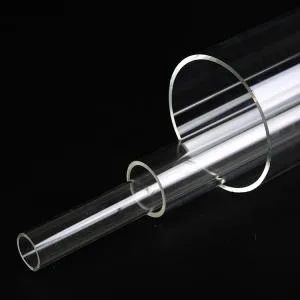
Quartz glass tube is drawn as fused quartz tubing of 99.997% purity, and that purity is what separates it from every other tubing material on this site. Where borosilicate begins to soften, quartz is still well inside its working range; where ordinary glass clouds under ultraviolet exposure, quartz continues to transmit. It is the material specified when the duty is genuinely beyond what borosilicate will take.
OVICTOR TECHNICAL GLASS supplies this tube cut to length from stock bores, item reference OV-013, for liquid level observation, furnace and heater work, semiconductor processing and solar applications.
The figures below are the published properties of the material as supplied.
Silica content: 99.997% SiO₂. Density: 2.2 g/cm³. Hardness: 6.6 on the Mohs scale.
Melting point: 1732°C. Softening point: 1630°C. Annealing point: 1180°C. Strain point: 1100°C.
Continuous working temperature: 1100°C. Maximum short-term temperature: 1450°C.
Visible light transmittance: above 93%. Ultraviolet spectral transmittance: 80%.
Acid tolerance: thirty times that of ceramics and one hundred and fifty times that of stainless steel. Electrical resistance: ten thousand times that of ordinary glass.
Trace elements are held to single-figure parts per million — aluminium 20 ppm, sodium and lithium 3.5 ppm each, magnesium and titanium 2.0 ppm, iron and calcium 1.0 ppm, with copper, lead and manganese lower still.
Four properties account for almost every order placed for quartz glass tube.
The 1100°C continuous figure is the one that decides most specifications. A quartz tube holds dimensional stability and optical clarity at temperatures that would soften borosilicate, which makes it the default for tube furnaces, heating elements, and sight ports into combustion equipment. The 1450°C short-term rating covers excursions and start-up transients rather than steady running.
Thermal shock resistance follows from the very low expansion coefficient of fused silica. A tube can be taken from ambient into a hot zone without the gradual ramp a soda lime or borosilicate tube requires, which shortens cycle times on batch equipment.
The 80% ultraviolet transmittance is why quartz tubular glass is used for UV lamp envelopes and sterilisation equipment: ordinary glass absorbs in exactly the band those applications depend on.
Chemical resistance is the fourth reason. At thirty times the acid tolerance of ceramics, the tube survives service that attacks metal fittings around it, which is why it appears in analytical and semiconductor process lines.
Quartz is not automatically the better choice — it costs more, and for a great many duties borosilicate is entirely adequate. The decision usually turns on three questions: does the working temperature exceed what borosilicate will hold; does the application depend on ultraviolet transmission; and is the thermal cycling fast enough that a low expansion coefficient is worth paying for. If the answer to all three is no, a borosilicate tube will do the same job for less.
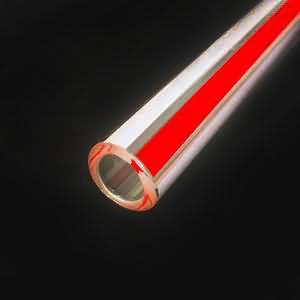
For level observation specifically, both materials are supplied as tubular sight glass, and the selection follows the vessel temperature rather than the tube itself.
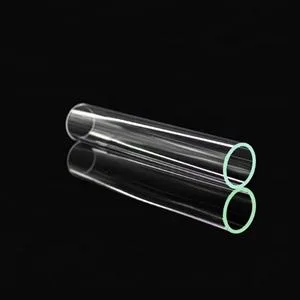
Quartz glass tube is supplied transparent, in a range of outside diameters and wall thicknesses, and cut to the length you specify. The information needed for a quotation is the outside diameter, the wall thickness or inside diameter, the cut length, the quantity, and the working temperature the tube will see in service.
Where the tube is replacing an existing one, the dimensions of the old part are sufficient. A high temperature glass tube ordered for furnace work should also be specified with the mounting arrangement in mind, since the seal at the cold end frequently determines the practical length.
Quotations are returned within 24 hours of a written enquiry. Samples are available free of charge with delivery charged and refunded against the subsequent order.
The continuous working temperature is 1100°C, with a maximum of 1450°C for short periods. Those figures apply to the material itself; the practical limit for an installation also depends on the seals and fittings at each end and on how quickly the tube is heated and cooled. State the working temperature and the cycle when enquiring so the wall thickness can be selected to suit.
Quartz holds a far higher working temperature, transmits ultraviolet light at around 80%, and has a much lower thermal expansion coefficient, so it tolerates rapid heating and cooling. Borosilicate costs considerably less and is entirely adequate below its own softening range. Unless the duty needs high temperature, UV transmission or fast thermal cycling, borosilicate is the sensible specification.
Yes. Tube is supplied cut to the length specified on the order rather than in fixed stock lengths. Supply the outside diameter, the wall thickness or inside diameter, the cut length and the quantity, and a quotation will be returned within 24 hours. Where an existing tube is being replaced, its dimensions are all that is needed.
The tube is drawn from fused silica at 99.997% SiO₂. Trace elements are held to single-figure parts per million — aluminium at 20 ppm is the highest, with sodium and lithium at 3.5 ppm and iron at 1.0 ppm. A technical data sheet giving the full chemical analysis is available on request.
 Scan to chat on WeChat